


Tom Hanks is one of the most recognizable American actors and filmmakers of his generation. Born on July 9, 1956, in Concord, California, he built a career that moved confidently between comedy, drama, romance, historical stories, and family entertainment. Tom Hanks became especially admired for bringing warmth, humor, intelligence, and emotional realism to memorable characters. His career includes major films such as Big, Philadelphia, Forrest Gump, Apollo 13, Saving Private Ryan, Cast Away, and Toy Story. His ability to connect with audiences has helped make him a lasting figure in popular cinema.
| Detail | Information |
|---|---|
| Full name | Thomas Jeffrey Hanks |
| Born | July 9, 1956 |
| Birthplace | Concord, California, U.S. |
| Profession | Actor, filmmaker, producer, writer |
| Known for | Forrest Gump, Philadelphia, Big, Toy Story |
| Major awards | Two Academy Awards, seven Emmys |
| Spouse | Rita Wilson |
| Children | Four |
| Active since | 1970s |
Early Life and Childhood
Tom Hanks spent his early years in California before moving with his family during childhood. His upbringing included several different communities, experiences that helped shape his adaptable personality. As a young person, he developed an interest in performance and storytelling. School theater offered an early path toward acting, while his natural sense of humor helped him become comfortable in front of audiences. These formative experiences did not guarantee Hollywood success, but they gave him the confidence and persistence needed to pursue professional acting.
Education and First Acting Steps

Tom Hanks studied theater at Chabot College and later attended California State University, Sacramento. His serious interest in acting developed through stage work, where he learned the importance of timing, character preparation, and collaboration. Professional theater became an important training ground before film and television offered larger opportunities. His stage experience helped him develop a grounded performance style. Instead of relying only on celebrity appeal, he built credibility by learning how to understand characters and communicate emotion naturally.
Television Breakthrough
The early television years gave Tom Hanks valuable exposure to audiences. His role in the sitcom Bosom Buddies helped establish him as a comedic performer and introduced his energetic screen presence. He also made appearances in other television programs before Hollywood began offering more substantial film opportunities. Television taught him how to work quickly and consistently while maintaining a believable character. Those skills became useful when he transitioned into leading film roles and began building a reputation for professionalism.
Rise Through Comedy Films
The 1980s were important in Tom Hanks’s rise to mainstream popularity. Movies such as Splash, Bachelor Party, The Money Pit, and Dragnet allowed him to demonstrate strong comic timing. His performances were often energetic without becoming overly theatrical. This balance helped audiences identify with his characters, even when the situations were exaggerated. Comedy established him as a dependable leading man, but his ambitions extended beyond humor. The next phase of his career would prove that he could handle serious subjects with equal confidence.
Big and a Major Career Turning Point
Big became a defining project for Tom Hanks. The 1988 fantasy comedy required him to portray an adult living with the innocence and wonder of a child, creating a performance that was funny while remaining emotionally sincere. The film became a major success and earned him his first Academy Award nomination for Best Actor. More importantly, it changed how filmmakers viewed his range. He was no longer simply a successful comedian; he had demonstrated that he could carry a film through charm, vulnerability, and dramatic skill.
Philadelphia and His First Oscar
Philadelphia marked a major transformation in Tom Hanks’s career. He played Andrew Beckett, a lawyer facing discrimination after his AIDS diagnosis. The performance required emotional restraint as well as physical and psychological commitment. Hanks received the Academy Award for Best Actor for the role, establishing a new level of dramatic credibility. The film also helped bring an important social issue to mainstream audiences. His work showed that he could approach difficult subjects with dignity rather than exaggeration, strengthening his reputation as a serious dramatic performer.
Forrest Gump and Second Oscar
Forrest Gump became one of the defining movies associated with Tom Hanks. His portrayal of the title character combined innocence, humor, vulnerability, and emotional depth. The film became a major cultural success, and Hanks won his second consecutive Academy Award for Best Actor. His back-to-back wins for Philadelphia and Forrest Gump placed him among a very small group of performers to achieve that distinction. The role also demonstrated his ability to make a fictional character feel deeply human while connecting the story to major moments in American history.
Apollo 13 and Historical Drama
Apollo 13 gave Tom Hanks another opportunity to portray a real person in an intense historical story. He played astronaut Jim Lovell in Ron Howard’s account of the 1970 lunar mission crisis. The movie combined technical detail with personal drama, requiring the cast to make complex events understandable and emotionally engaging. Hanks’s controlled performance helped anchor the story. The success of Apollo 13 reinforced his reputation for leading serious films while maintaining an accessible screen presence.
Saving Private Ryan and War Stories
Saving Private Ryan expanded Tom Hanks’s dramatic range through a demanding World War II role. He portrayed Captain John Miller, a soldier leading a dangerous mission behind enemy lines. Steven Spielberg’s film became known for its intense depiction of combat and its focus on sacrifice, duty, and friendship. Hanks gave Miller a quiet authority rather than a stereotypical heroic style. His collaboration with Spielberg became particularly important, leading to several additional projects in film and television.
Toy Story and Woody
The Toy Story franchise introduced another important side of Tom Hanks’s talent. As the voice of Sheriff Woody, he helped create a character whose personality could be understood through voice, rhythm, emotion, and timing alone. Woody became one of animation’s most recognizable characters, and Hanks returned to the role across multiple installments. The performance also connected him with younger audiences and families worldwide. His work in animation demonstrated that his appeal did not depend on appearing physically on screen.
Romantic Comedy Success
Tom Hanks also became strongly associated with romantic comedies. Sleepless in Seattle and You’ve Got Mail paired him with Meg Ryan and created enduring examples of modern romantic storytelling. His performances worked because they combined humor with vulnerability and emotional restraint. Rather than presenting romance as perfect or effortless, he often played characters who felt uncertain, awkward, or genuinely hopeful. These films strengthened his reputation as an actor capable of moving comfortably between major genres.
Cast Away and Physical Transformation
Cast Away presented Tom Hanks with an unusually demanding performance challenge. He played Chuck Noland, a man stranded alone after a plane crash. Much of the movie required him to communicate without extensive dialogue, making physical expression and facial reactions essential. Hanks underwent a significant physical transformation for the role, reinforcing the character’s isolation and survival experience. His performance earned another Academy Award nomination. The film remains an example of how he could carry a story through presence, restraint, and emotional detail.
Directing and That Thing You Do!
Tom Hanks expanded his creative work by writing and directing That Thing You Do! The film follows a fictional band and its sudden rise to fame, blending music, comedy, and nostalgia. His move behind the camera showed that his interests extended beyond acting. Directing gave him greater involvement in storytelling, pacing, performance, and production. He continued developing as a filmmaker and producer, later taking important roles in television projects and historical productions.
Producing and Television Achievements
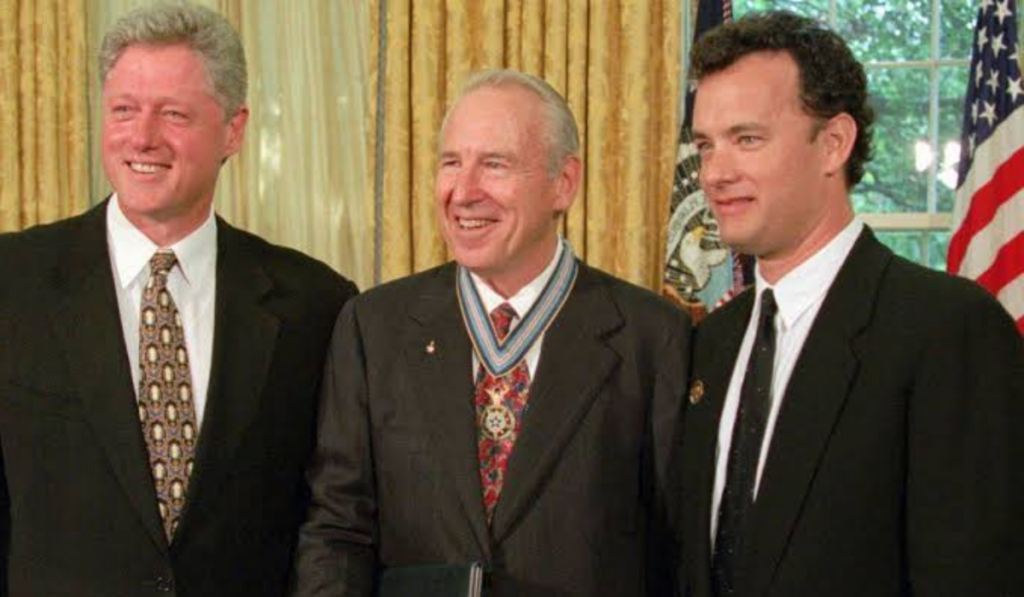
Tom Hanks became an influential producer as well as a performer. Through Playtone, the production company he co-founded with Gary Goetzman, he worked on major television and film projects. His producing credits include acclaimed historical and dramatic productions such as From the Earth to the Moon, Band of Brothers, John Adams, and The Pacific. His television work earned multiple Emmy Awards. This side of his career demonstrated his interest in developing stories rather than simply appearing in them.
Collaborations With Steven Spielberg
The professional relationship between Tom Hanks and Steven Spielberg became one of the most notable actor-director partnerships in modern Hollywood. Their collaborations include Saving Private Ryan, Catch Me If You Can, The Terminal, Bridge of Spies, and The Post. They also worked together on Band of Brothers. Across these projects, Hanks played characters ranging from soldiers and diplomats to ordinary people caught in extraordinary circumstances. Their repeated collaboration reflects the trust that can develop when an actor and filmmaker share a strong storytelling approach.
Broadway and Stage Work
Tom Hanks returned to the stage with Lucky Guy, written by Nora Ephron. The Broadway production marked an important chapter because it brought him back to the theatrical environment where his professional ambitions had begun. His performance earned a Tony Award nomination for Best Actor in a Play. Stage acting demands a different kind of discipline from film because performers must sustain character and emotion before a live audience. His Broadway work demonstrated that he remained interested in challenging himself beyond conventional movie roles.
Later Career and Mature Performances
Tom Hanks continued taking varied roles as his career progressed. Films such as Captain Phillips, Saving Mr. Banks, Sully, The Post, A Beautiful Day in the Neighborhood, Greyhound, News of the World, and A Man Called Otto showed his willingness to explore different personalities and themes. He also appeared in films by directors with distinctive styles, including Wes Anderson. His later performances often emphasized maturity, responsibility, compassion, and resilience, qualities that have become closely associated with his screen persona.
Recent Projects and Continuing Work
In recent years, Tom Hanks has remained active in film, television, narration, and voice performance. His work has included projects such as Here, The Phoenician Scheme, and Toy Story 5, along with documentary and historical productions. He has continued combining acting with producing and narration. His ongoing presence demonstrates unusual career longevity. Rather than relying only on earlier successes, he has continued participating in new productions and working with filmmakers across different genres.
Awards and Major Honors
Tom Hanks has received two Academy Awards for Best Actor and has also earned multiple Emmy Awards for television work. His broader honors include the AFI Life Achievement Award, Kennedy Center Honors, and the Presidential Medal of Freedom. These recognitions reflect more than box-office success. They acknowledge his contributions across acting, producing, television, and American cultural life. His award history is particularly notable because it spans several decades and different forms of entertainment.
Family and Personal Life
Tom Hanks has been married to actress and singer Rita Wilson since 1988. Their family life has remained an important part of his public story, although both have maintained professional identities of their own. Hanks has four children and has supported creative projects involving family members. He has often spoken positively about collaboration, gratitude, and long-term relationships. His personal life is generally viewed as more private than the highly publicized careers of many Hollywood stars.
Philanthropy and Public Recognition
Tom Hanks has supported charitable and cultural causes throughout his career. His public recognition has also included honors connected with American history and civic life. His involvement with World War II storytelling, historical documentaries, and veterans-related projects has helped bring educational subjects to broad audiences. Rather than limiting his influence to entertainment, he has frequently participated in projects that connect popular culture with history, public memory, and national conversation.
Influence on Hollywood
Tom Hanks has influenced Hollywood through consistency, versatility, and an ability to make characters relatable. His career demonstrates how an actor can move from comedy to serious drama without losing audience trust. He has also shown how performers can expand into producing, writing, directing, narration, and stage work. His reputation for professionalism has become part of his legacy. For many viewers, his films represent a combination of strong storytelling and emotionally accessible performances.
Why Audiences Connect With Him
The lasting appeal of Tom Hanks comes partly from his ability to make extraordinary stories feel personal. Whether playing an astronaut, soldier, lawyer, castaway, neighbor, or animated cowboy, he often emphasizes recognizable human emotions. His characters can be humorous without seeming foolish and serious without becoming distant. This balance creates a sense of familiarity. Audiences may not share the circumstances of his characters, but they can usually recognize their hopes, fears, mistakes, and determination.
Legacy and Cultural Impact
Tom Hanks has built a legacy that reaches across generations. His films are frequently revisited, while characters such as Woody remain familiar to younger audiences. His work in historical drama has also helped popularize stories about war, space exploration, politics, journalism, and public service. Beyond individual performances, his career shows the value of adaptability. By combining acting with producing, directing, writing, narration, and stage performance, he has created a body of work that extends well beyond the traditional movie-star model.
Career Lessons From His Journey
The career of Tom Hanks offers several useful lessons for aspiring performers. First, versatility can create long-term opportunities. Second, professional growth often requires taking risks and accepting unfamiliar roles. Third, credibility can be built gradually through consistent work. Finally, success does not have to end when a performer reaches the top of one field. Hanks continued expanding into production, television, theater, and voice work, showing that a long career can be sustained through curiosity and creative development.
Frequently Asked Questions
- What is Tom Hanks best known for? – He is best known for films including Forrest Gump, Philadelphia, Big, Apollo 13, Saving Private Ryan, Cast Away, and the Toy Story series.
- How many Oscars has Tom Hanks won? – He has won two Academy Awards for Best Actor, for Philadelphia and Forrest Gump.
- Who is Tom Hanks married to? – He has been married to actress and singer Rita Wilson since 1988.
- Has Tom Hanks worked as a producer? – Yes, he has produced numerous film and television projects and has been involved with acclaimed historical miniseries.
- What is Tom Hanks’s latest major work? – His recent work includes Toy Story 5 and historical and documentary projects released during 2026.
Tom Hanks remains a defining figure in American entertainment because his career combines popular success, dramatic credibility, creative leadership, and remarkable longevity. From early comedy roles to award-winning dramas, animation, television production, Broadway, and historical storytelling, his work has reached audiences across generations. His biography also illustrates how sustained curiosity can keep a performer relevant for decades. For additional background and a broader overview of his career, see the related Wikipedia biography.