

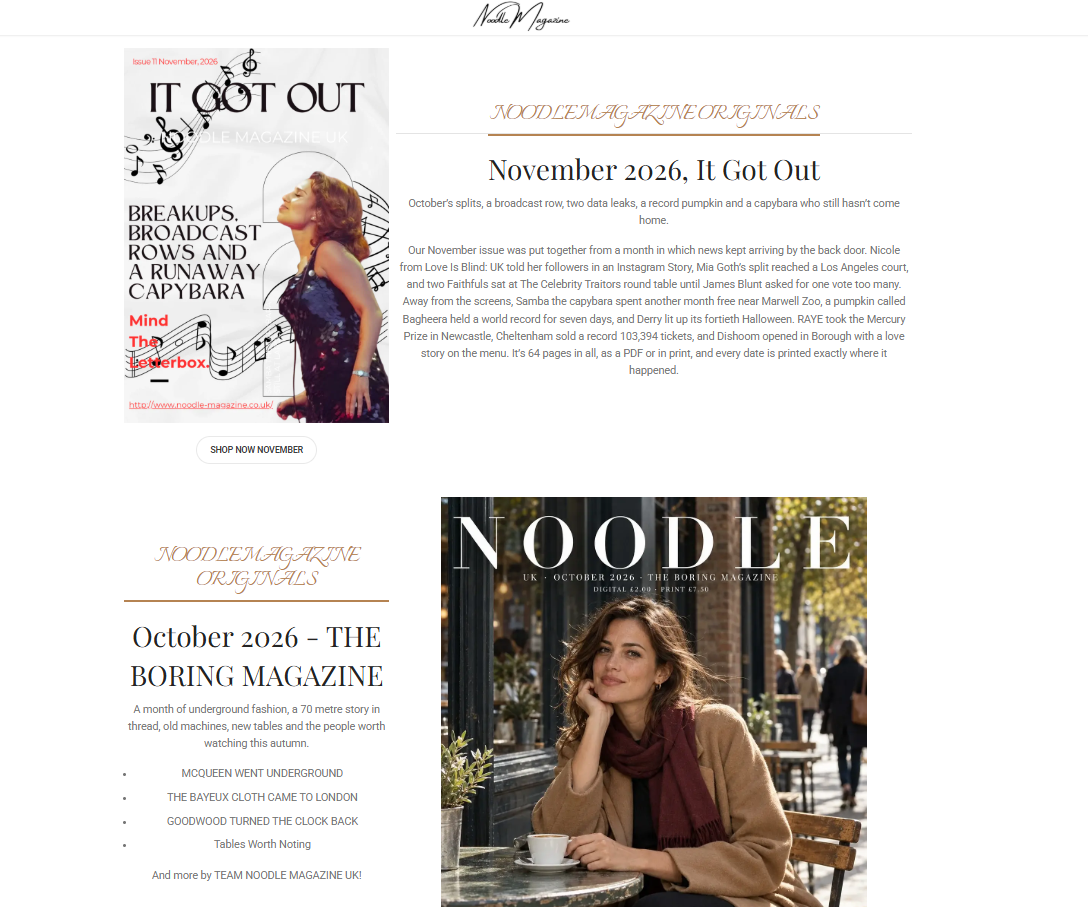
One issue named itself boring. The next one sounded like a leaked memo. Noodle Magazine UK released The Boring Magazine for October 2026 and followed it four weeks later with It Got Out for November, and placed side by side the two read less like consecutive issues than like two siblings who refuse to share a bedroom. Same publisher, same price, same choice of PDF or print. Almost nothing else overlaps, which is exactly what makes the pair worth comparing.
The Titles Already Tell You Which Reader Each Issue Wants
October describes itself as “September kept”, a record of a month that had already happened plus a little planning for the one ahead. November was assembled, in the publisher’s own words, from a month in which news kept arriving by the back door. One issue sits down with a pot of tea. The other keeps checking its phone.
| October: The Boring Magazine | November: It Got Out | |
| Covers | September 2026, kept for the record | October 2026, as it leaked out |
| Lead story | McQueen’s return to London Fashion Week | Celebrity splits and what was actually confirmed |
| Culture | Bayeux Tapestry, Goodwood Revival, BFI preview | Mercury Prize, Cheltenham, Derry Halloween |
| Odd corner | 300 vintage scooters on a race track | A missing capybara and a seven-day pumpkin record |
| Price | £2.00 to £8.50, PDF or print | £2.00 to £8.50, PDF or print |
October Spent Its Pages on Things Worth Looking at Slowly
The fashion chapter opens underground, quite literally. Seán McGirr showed McQueen’s Spring/Summer 2027 collection on 20 September in the vaulted undercroft of Lincoln’s Inn Chapel in Holborn, the first time the house had been on the official London Fashion Week schedule since 2001. Several pieces were made with Huntsman, the Savile Row tailor that once cut Lee McQueen’s own clothes. The magazine reads the show look by look, which suits a collection built on the idea that a quiet suit can still be worn by a loud person.
Culture takes an even longer view. The Bayeux Tapestry went on display at the British Museum on 10 September and stays until 11 July 2027, roughly 70 metres of eleventh-century embroidery in the UK for the first time in nearly a thousand years. Tickets for the first four months had sold out. Then the issue heads south to the Goodwood Revival, held from 18 to 20 September, where a parade of around 300 pre-1967 scooters opened each day to mark 80 years of Vespa, and Maserati marked a century since its first Targa Florio win.
Food and film close it out. Time Out’s autumn restaurant openings are written up with a reader’s notebook attached, and the 70th BFI London Film Festival is pencilled in at the back: 7 to 18 October, 251 titles from 88 countries, Simon Stone’s Elsinore with Andrew Scott opening and Jesse Eisenberg’s The Debut closing. Nothing here is urgent. That is rather the point.
November Followed Whatever Slipped Into Public View
The tone shifts the moment the cover turns. It Got Out opens on relationship news and is careful about it, separating a court filing from a public announcement and both from plain rumour. Television gets its share too, with The Celebrity Traitors finale and a Strictly rehearsal shirt that was blurred before broadcast.
Then the issue gets gloriously strange. Samba the capybara, missing from Marwell Zoo since 17 March, was still at large when the pages closed. Ian Paton’s pumpkin Bagheera held the world heavyweight record at 1,295.8 kg for precisely seven days before Ron Wallace in Rhode Island beat it with 1,431.5 kg. A first-time player dressed as a tiger won the World Conker Championships, the Bank of England picked a puffin, a barn owl, a bumblebee and a hedgehog for its next banknotes, and Derry celebrated forty years of Halloween. Two data leaks and a police referral sit alongside all of that, which gives the issue a spine under the fun.
Both Issues Treat Dates and Pictures as Evidence
For all their differences, the two share a habit that most monthly titles have quietly dropped. October draws a clear line between record and preview: its September pages describe what happened, while the BFI section was prepared from the programme announced on 2 September, so screening times are left to the festival’s own listings. Every photograph is either credited beside the frame or, where the scene is the magazine’s own creation, labelled as AI on the page.
November pushes the same instinct further and prints every date exactly where the event happened. In a month of leaks and claims, that small discipline does a lot of work. A reader can tell at a glance what was known and when, and a printed date cannot be quietly edited afterwards the way a web page can.
The Better Buy Depends on How Fast a Reader Likes a Month to Move
At the same price, the choice comes down to temperament. The Boring Magazine suits anyone who wants a month laid out like a well-hung exhibition, with fashion, history and machinery given room to breathe. It Got Out suits the reader who enjoys the news more when it arrives with a raised eyebrow and a timestamp.
Taken together, the two issues make a quiet case for monthly print. One shows what a month looks like once the dust has settled. The other shows what it looked like while the dust was still in the air. Most publications pick one of those jobs. Noodle Magazine UK did both, in consecutive months, and gave each a name that tells the reader exactly what they are getting.