

Human Resources (HR) management has evolved significantly over the years. Modern HR professionals are no longer responsible only for recruitment, employee records and workplace administration. They are increasingly expected to make informed decisions, analyse workforce data, understand employee behaviour and develop strategies that support organisational performance.
This shift has made evidence-based HR management an essential part of professional practice across UK organisations. Instead of relying entirely on personal opinions or traditional workplace practices, HR professionals use research, organisational information and employee feedback to identify problems and develop effective solutions.
For students pursuing CIPD qualifications and professionals developing their HR careers, understanding evidence-based practice is particularly important. It requires a combination of research skills, critical analysis, problem-solving abilities and effective academic writing.
This article explores how evidence-based HR management works, why research and analysis matter, and how developing strong academic writing skills can improve both professional practice and academic performance.
What Is Evidence-Based HR Management?
Evidence-based HR management is an approach to making people-related decisions using reliable information, research findings, organisational data and professional expertise.
Rather than introducing a new HR policy simply because another organisation uses it, an evidence-based professional examines whether the proposed approach is appropriate for their organisation.
For example, imagine a UK organisation experiencing a high employee turnover rate. Management may initially believe that employees are leaving because of salary dissatisfaction. However, relying on this assumption could lead to unnecessary salary increases without addressing the actual problem.
An evidence-based HR professional would investigate the situation by examining:
- Employee turnover and retention data.
- Staff satisfaction surveys.
- Exit interview feedback.
- Industry research on employee retention.
- Management practices and workplace conditions.
By combining these sources, HR professionals can identify the underlying reasons behind employee turnover and recommend more appropriate solutions.
According to the Chartered Institute of Personnel and Development (CIPD), evidence-based practice involves using the best available evidence from multiple sources to improve professional decisions and organisational outcomes.
CIPD+1
Why Is Evidence-Based Practice Important in Human Resources?
HR decisions can directly affect employees, organisational culture, productivity and business performance. Making these decisions without sufficient information can create unnecessary risks and lead to ineffective workplace policies.
Evidence-based practice helps HR professionals develop more reliable approaches to managing people and organisational challenges.
1. Improves HR Decision-Making
One of the main benefits of evidence-based HR management is that it reduces dependence on assumptions and personal opinions.
For instance, when deciding whether to introduce flexible working arrangements, HR professionals can examine employee feedback, productivity measures, operational requirements and relevant research.
This provides a stronger foundation for deciding whether flexible working is suitable for the organisation.
2. Supports Employee Engagement and Retention
Understanding employee needs is essential for creating a positive working environment.
HR professionals can analyse engagement surveys, absence records, exit interviews and performance information to identify factors affecting employee satisfaction.
These findings can help organisations develop more effective employee retention strategies, improve workplace communication and address management issues.
3. Strengthens Organisational Performance
Evidence-based HR decisions can help organisations use their workforce more effectively.
For example, analysing recruitment costs, employee productivity and training outcomes can reveal whether existing people management practices are delivering value.
HR teams can then recommend improvements that support business objectives while considering employee needs.
4. Reduces Bias and Unnecessary Risks
Personal preferences and assumptions can influence workplace decisions. Evidence-based approaches encourage HR professionals to examine different perspectives and assess the reliability of available information.
This is particularly important when dealing with recruitment, performance management, employee relations and workplace policies.
The Four Main Sources of Evidence in HR Management
Effective evidence-based practice does not depend on a single source of information. HR professionals should consider different types of evidence before making important decisions.
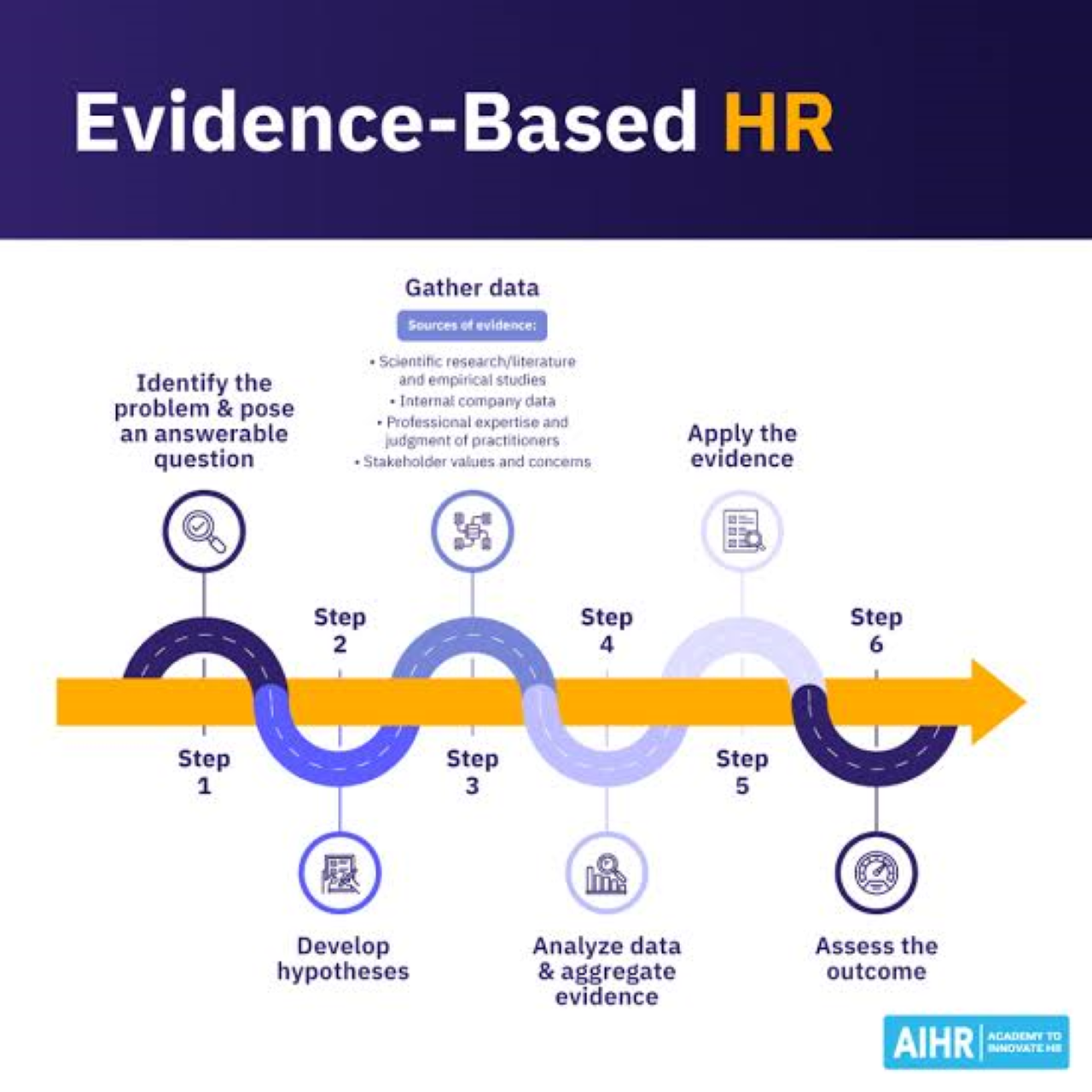
The CIPD identifies four key sources that contribute to evidence-based professional practice.
1. Scientific Research and Academic Literature
Scientific research provides insights into workplace behaviour, organisational performance and effective people management practices.
HR professionals can use academic journals, research papers, systematic reviews and professional publications to understand what previous studies have discovered.
For example, research on employee motivation may help HR teams understand how recognition, career development and management support influence workplace engagement.
However, it is important to evaluate research quality rather than accepting every published finding without question.
2. Organisational Data
Organisational data provides information about what is happening within a particular business.
This evidence may include:
- Employee turnover rates.
- Recruitment and selection costs.
- Staff absenteeism records.
- Employee engagement scores.
- Training completion rates.
- Performance management results.
- Employee satisfaction surveys.
For example, if an organisation notices an increase in absenteeism, HR professionals can compare absence records across departments and investigate possible contributing factors.
3. Professional Expertise
Professional expertise involves using the knowledge and experience of HR practitioners, managers and other relevant professionals.
Experienced HR professionals can provide valuable insights into workplace challenges, employee relationships and organisational practices.
However, professional judgement should be considered alongside other evidence rather than treated as the only basis for a decision.
4. Stakeholder Opinions and Feedback
Stakeholders include employees, managers, senior leaders and other individuals affected by HR decisions.
Their opinions can help organisations understand workplace experiences that may not be visible through numerical data.
HR professionals can collect stakeholder feedback through interviews, focus groups, consultation meetings and employee surveys.
For example, before introducing a new performance management system, an organisation may consult managers and employees to understand their concerns and expectations.
Combining these four evidence sources helps HR professionals develop a more balanced understanding of workplace problems.
CIPD+1
How HR Professionals Conduct Research and Analyse Workplace Problems
Research and analysis are essential skills for identifying organisational challenges and developing practical HR solutions.
A structured approach helps professionals move from identifying a problem to evaluating possible solutions.
Step 1: Identify the HR Problem
The first step is to understand the issue that needs investigation.
For example, an organisation may be experiencing declining employee engagement. Instead of immediately introducing a new reward programme, HR professionals should investigate why engagement levels are falling.
A clearly defined research question helps establish the direction of the investigation.
Step 2: Collect Relevant Information
Once the problem has been identified, HR professionals need to gather appropriate information.
Depending on the issue, this may involve collecting internal workforce data, reviewing academic research, conducting interviews or distributing employee surveys.
The information collected should be relevant to the research question and sufficiently reliable to support further analysis.
Step 3: Evaluate the Quality of Evidence
Not all information has the same level of reliability.
HR professionals should consider where the evidence comes from, when it was published, how it was collected and whether the research methods are appropriate.
For example, a survey involving a small and unrepresentative group of employees may not accurately reflect the experiences of the entire workforce.
Similarly, a research study conducted in a very different organisational environment may not provide directly transferable findings.
Step 4: Analyse the Findings
After collecting information, HR professionals need to identify patterns, relationships and possible explanations.
Common analysis techniques include:
- SWOT analysis to evaluate organisational strengths, weaknesses, opportunities and threats.
- PESTLE analysis to examine external political, economic, social, technological, legal and environmental factors.
- Root cause analysis to identify underlying workplace problems.
- The 5 Whys technique to investigate why an issue occurs.
- Workforce analytics to examine employee-related data and trends.
The selected method should match the problem being investigated.
Step 5: Develop Evidence-Based Recommendations
The final stage involves using the findings to recommend practical solutions.
For example, if research identifies poor management communication as a major contributor to employee dissatisfaction, HR may recommend leadership development, regular feedback sessions and improved internal communication processes.
Recommendations should consider organisational resources, employee needs, potential risks and expected outcomes.
Step 6: Measure the Impact
Introducing a new HR practice is not the end of the process.
Professionals should evaluate whether the recommended changes have achieved their intended objectives.
This could involve comparing employee engagement scores, turnover rates, absence levels or productivity measures before and after implementation.
Regular evaluation helps organisations identify improvements and make better-informed decisions in the future.
CIPD+1
Research Methods Used in Evidence-Based HR Management
HR professionals use different research methods depending on the type of organisational problem they want to investigate. Understanding these methods helps them collect relevant information and develop more reliable conclusions.
Quantitative Research
Quantitative research focuses on numerical information that can be measured and analysed statistically.
In HR management, it may involve:
- Employee engagement surveys.
- Staff turnover statistics.
- Absenteeism records.
- Recruitment performance data.
- Employee productivity measurements.
For example, an HR department may conduct a survey to measure employee satisfaction across different departments. The results can help identify areas where management practices need improvement.
Qualitative Research
Qualitative research focuses on experiences, opinions, attitudes and behaviours rather than numerical measurements.
Common methods include:
- Employee interviews.
- Focus group discussions.
- Workplace observations.
- Open-ended survey questions.
- Case studies.
For example, HR professionals may interview employees who recently resigned to understand their reasons for leaving. Their responses can reveal management or workplace issues that numerical data alone may not explain.
Mixed-Methods Research
Mixed-methods research combines quantitative and qualitative approaches to provide a broader understanding of an issue.
For instance, an organisation investigating employee turnover may analyse resignation statistics and conduct interviews with former employees.
The numerical data helps identify patterns, while interviews provide further insight into the reasons behind those patterns.
Using both approaches can help HR professionals develop more informed recommendations.
The Role of Critical Thinking in HR Research and Analysis
Collecting information is only one part of evidence-based HR management. Professionals must also understand how to interpret findings, identify limitations and distinguish reliable evidence from unsupported claims.
Critical thinking allows HR practitioners to question assumptions rather than accepting information at face value.
For example, an organisation may discover that employees who receive additional training achieve higher performance scores. However, this does not automatically prove that training is the only reason for improved performance.
Other factors, such as management support, previous experience and employee motivation, may also influence the results.
When evaluating research, HR professionals should consider the following questions:
- Is the information relevant to the issue being investigated?
- Is the research source reliable and credible?
- Are the findings supported by sufficient evidence?
- Could personal bias have influenced the results?
- Are there alternative explanations for the findings?
- Can the recommendations realistically be applied within the organisation?
Developing these skills helps HR professionals make balanced decisions and communicate recommendations with greater confidence.
Why Academic Writing Skills Matter in HR Management
Academic writing plays an important role in developing professional knowledge, particularly for individuals pursuing CIPD qualifications.
HR professionals and students regularly need to explain workplace problems, evaluate research findings, compare different perspectives and present recommendations in a structured manner.
Strong academic writing helps communicate complex ideas clearly while demonstrating an understanding of relevant theories, evidence and professional practices.
1. Developing Clear and Logical Arguments
Academic writing requires more than presenting information. Students must explain how their findings relate to the research question and why particular conclusions are justified.
For example, when discussing employee engagement, a learner should not simply define the concept. They should examine relevant research, consider organisational examples and explain how different management approaches influence employee motivation.
2. Using Reliable Academic Sources
Research-based assignments require information from credible sources, including academic journals, professional publications, research reports and relevant textbooks.
Students should avoid depending entirely on general websites or unsupported online statements.
Using reliable sources strengthens arguments and helps demonstrate a clear understanding of the subject.
3. Developing Critical Analysis
Critical analysis involves examining information, comparing different viewpoints and evaluating the strengths and limitations of existing research.
For instance, when evaluating a recruitment strategy, students may compare traditional recruitment methods with digital recruitment approaches and assess their effectiveness in different organisational contexts.
4. Understanding Referencing and Academic Integrity
Proper referencing is essential in academic writing. Students must acknowledge the original sources of ideas, research findings and information used in their assignments.
Accurate referencing helps prevent plagiarism, supports academic credibility and allows readers to verify the information presented.
Learners should follow their institution’s required referencing style and maintain clear records of their research sources.
Applying Evidence-Based Practice in CIPD Assignments
Evidence-based practice is particularly relevant to CIPD learners because their assessments often require them to connect HR theories with real workplace situations.
At Level 5, students are expected to demonstrate an ability to understand organisational challenges, analyse relevant information and develop practical recommendations.
For example, an assignment about employee retention may require learners to examine workforce data, discuss relevant motivation theories and evaluate strategies that organisations can use to reduce employee turnover.
These assessments can become challenging when students struggle to interpret assignment briefs, organise research or develop analytical arguments.
Learners who need additional academic guidance can explore cipd level 5 assignment help online through CIPDAssessmentCom. Understanding assessment criteria, learning outcomes and appropriate research methods can help students approach their assignments more effectively.
Developing Professional Research and Writing Skills for Long-Term Career Growth
Research, analysis and academic writing are not skills that are useful only during professional qualifications. They also contribute to long-term development within the HR profession.
An HR professional who can evaluate organisational information, interpret research and communicate findings effectively is better positioned to contribute to management discussions and workplace improvements.
These capabilities become particularly valuable when dealing with complex issues such as organisational restructuring, workforce planning, employee relations and talent development.
Students who want to strengthen their academic research, writing structure and referencing skills can also explore CIPD Assignment Writing UK through EliteAssignmentsCoUK. Access to relevant academic guidance can help learners better understand writing expectations and develop their independent research abilities.
It is important to remember that academic support should complement individual learning. Students remain responsible for producing their own work and following their institution’s academic integrity policies.
Common Challenges in Evidence-Based HR Management
Although evidence-based practice offers several benefits, implementing it effectively can present challenges for HR professionals.
Understanding these limitations is important when developing research skills and evaluating organisational decisions.
Limited access to reliable research: Some organisations may not have access to academic journals, specialist databases or professional research resources. This can make it difficult to identify high-quality evidence.
Poor data quality: Incomplete employee records, outdated information and inconsistent reporting can affect the accuracy of HR analysis.
Lack of analytical skills: HR professionals may understand workplace issues but struggle to interpret statistical information or evaluate research findings.
Resistance to organisational change: Managers and employees may resist recommendations that challenge existing workplace practices, particularly when they are based on unfamiliar research findings.
Time and resource constraints: Conducting detailed research, collecting employee feedback and evaluating different solutions requires time, suitable resources and organisational support.
Addressing these challenges requires continuous professional development, better access to reliable information and a workplace culture that values informed decision-making.
Final Thoughts
Evidence-based HR management is essential for professionals who want to make informed decisions and contribute meaningfully to organisational success.
By combining scientific research, organisational data, professional expertise and stakeholder feedback, HR practitioners can develop a deeper understanding of workplace challenges and recommend more effective solutions.
Research and analytical skills help professionals identify problems and evaluate potential improvements, while academic writing enables them to communicate their findings clearly and support their recommendations with credible evidence.
For CIPD students, developing these capabilities is equally important. Whether studying at Level 3, Level 5 or Level 7, the ability to research, analyse and present information effectively can strengthen academic performance and prepare learners for real-world HR responsibilities.