



MathPlayZone is a useful topic for families, students, teachers, and anyone interested in combining mathematics with interactive entertainment. Educational gaming can make learning more enjoyable by turning numbers, calculations, and logical challenges into activities that encourage curiosity and regular practice. This guide explores what MathPlayZone may offer, how math games can support learning, and what users should consider when choosing online educational activities. Because specific platform details may change, the article distinguishes general educational benefits from features that should be verified on the official service.
| Quick Bio Detail | Information |
|---|---|
| Name | MathPlayZone |
| Category | Educational gaming and mathematics learning |
| Main topic | Math practice through games |
| Intended audience | Students, parents, and teachers |
| Learning focus | Arithmetic, logic, problem-solving, and number skills |
| Access | Depends on the platform and available services |
| Primary purpose | Making mathematics practice more engaging |
1. What Is MathPlayZone?
MathPlayZone is a search term associated with the idea of making mathematics more entertaining through games and interactive learning. Platforms in this category generally aim to help learners practice essential skills while enjoying puzzles, challenges, and activities. The exact selection of games, age groups, and learning tools should be confirmed before describing any particular website feature as available. Understanding this distinction helps readers evaluate the platform accurately without confusing general educational gaming benefits with verified product information.
2. The Idea Behind Educational Math Games
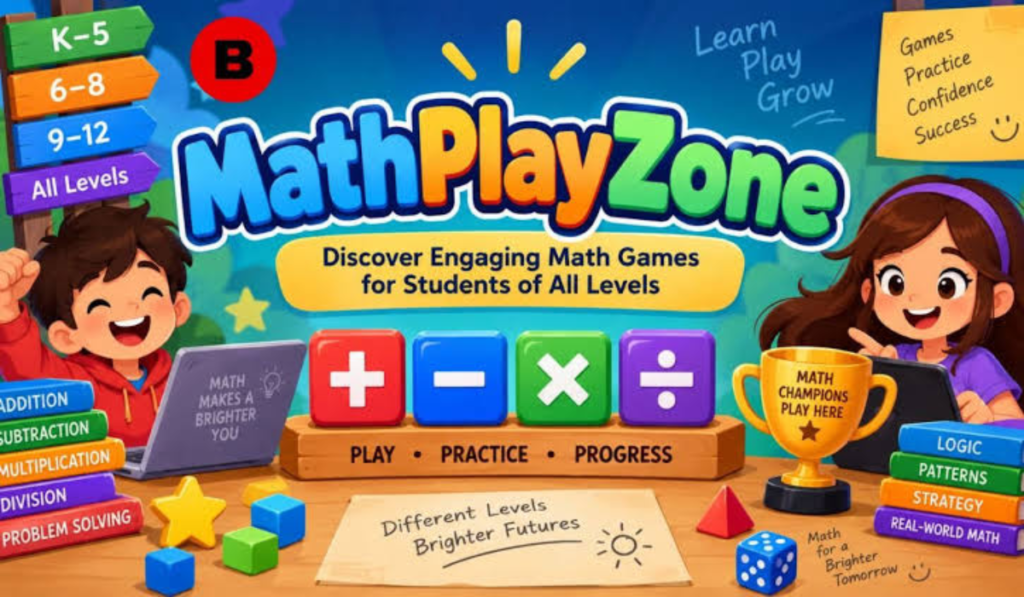
Educational math games combine learning objectives with playful experiences. Instead of relying exclusively on worksheets or repeated calculations, learners can solve problems within challenges that provide goals and feedback. This approach can encourage participation, especially among children who find traditional exercises difficult or repetitive. Games work best when entertainment supports a clear educational purpose, allowing learners to practice specific concepts while gradually improving their confidence and accuracy.
3. Why Math Learning Matters
Mathematics is useful in everyday life, education, technology, and many professional fields. Counting, estimating, calculating percentages, understanding measurements, and interpreting data are skills people use regularly. Early familiarity with mathematical concepts can also prepare students for more advanced subjects, including algebra, geometry, statistics, and computer science. Regular practice helps learners recognize patterns and develop logical reasoning, making mathematics an important part of a balanced educational experience.
4. Who Can Benefit From MathPlayZone?
Students who enjoy interactive activities may find math games an appealing addition to their usual studies. Parents can use suitable games to supplement learning at home, while teachers may consider digital activities for classroom practice. Older learners can also benefit from puzzles that strengthen mental arithmetic and logical thinking. The best activity depends on the learner’s age, existing knowledge, educational goals, and comfort with technology rather than on entertainment value alone.
5. Mathematics for Young Children
Young children often begin learning mathematics through counting, recognizing numbers, comparing quantities, and identifying simple patterns. Colorful activities and clear visual examples can help make these ideas easier to understand. Games involving objects, shapes, and basic addition may provide useful practice when they are appropriate for a child’s developmental stage. Parents should choose age-suitable activities and remain available to explain mistakes, encourage questions, and connect digital exercises with real-world examples.
6. Addition Games and Number Recognition
Addition is one of the first mathematical skills children learn. Games that ask players to combine quantities can help them understand how numbers relate to one another. For example, a learner might answer simple sums to earn points, complete a mission, or advance to another stage. These activities can reinforce number recognition and calculation speed. Beginners should start with small numbers before progressing to larger sums, ensuring that accuracy and understanding remain more important than speed.
7. Subtraction and Mental Arithmetic
Subtraction helps students understand differences, missing quantities, and the relationship between numbers. Interactive exercises can provide repeated opportunities to practice these concepts without making every session feel like a formal test. Learners might calculate how many objects remain after some are removed or solve subtraction equations under a time limit. Such practice can strengthen mental arithmetic when combined with explanations and untimed exercises. Students should be encouraged to understand their mistakes instead of simply restarting a game to obtain a better score.
8. Multiplication Practice Through Games
Multiplication becomes easier when students understand that it represents repeated addition and groups of equal size. Games can provide opportunities to practice multiplication tables and recognize numerical patterns. For instance, a challenge may require a learner to solve multiplication questions before reaching a goal. Repeated practice can improve recall, but memorizing answers is only one part of learning. Using arrays, objects, and real-life examples alongside digital exercises helps children understand why multiplication works and when to use it.
9. Division and Mathematical Reasoning
Division teaches learners how to share quantities equally and determine how many groups can be formed from a particular amount. It can be challenging when students are still developing multiplication skills. Games that use visual objects, simple equations, and gradually increasing difficulty may help make the concept more approachable. Learners should practice both exact division and problems involving remainders when appropriate for their grade. Connecting division with everyday situations, such as sharing snacks or arranging objects, can make the calculations easier to understand.
10. Logic Puzzles and Strategic Thinking
Logic puzzles encourage players to identify patterns, test possibilities, and make decisions based on available information. Not every puzzle needs to involve direct arithmetic to support mathematical thinking. Number sequences, block arrangements, and strategy challenges can all help learners practice reasoning. The official website lists games such as Math Push, which combines numbered blocks with mathematical expressions. These activities may offer a different kind of challenge from traditional calculation exercises.
11. Timed Challenges and Learning Motivation
Timed games can make simple arithmetic feel exciting by introducing a clear objective and a limited amount of time. They may encourage learners to recall familiar facts more quickly and stay focused on a task. However, time pressure does not suit every student, particularly those who experience mathematics anxiety or need additional processing time. A balanced learning routine should include both timed and untimed activities. The aim is to develop reliable mathematical understanding first and improve speed gradually through regular practice.
12. Benefits for Students
Digital mathplayzone games can give students another way to engage with concepts they encounter in school. They may support repetition, active participation, and independent practice. Learners can also discover which topics they enjoy and which require more attention. The effectiveness of an activity depends on its educational quality, difficulty, and relevance to the student’s needs. Students should use games as a supplement to lessons, textbooks, discussions, and written exercises rather than treating a high game score as proof that every concept has been mastered.
13. How Parents Can Support Learning
Parents can make online learning more productive by choosing suitable activities and discussing what their children have learned. Rather than focusing only on points or completion times, they can ask children to explain how they reached an answer. This conversation helps reveal whether the child understands the underlying concept. Families can also connect game questions to shopping, cooking, counting toys, and measuring ingredients. A supportive atmosphere makes it easier for children to ask questions and treat mistakes as opportunities to improve.
14. Using Math Games in the Classroom
Teachers can incorporate suitable games into warm-up activities, revision sessions, learning stations, or optional practice assignments. A short challenge may help students revisit a concept before moving to a more complex lesson. Teachers should review the content beforehand and check that the questions align with classroom objectives. They should also consider whether all students have access to suitable devices and reliable internet. Combining digital play with group discussions and written problem-solving helps ensure that entertainment supports meaningful learning.
15. Choosing the Right Difficulty Level
An activity should be challenging enough to encourage progress without becoming so difficult that a learner loses interest. Beginners may need simple counting tasks, while more experienced students might prefer multiplication, division, or multistep puzzles. If a game feels too easy, choosing a more advanced challenge can keep practice useful. If errors occur repeatedly, returning to a simpler level may help rebuild understanding. Matching difficulty to ability encourages gradual progress and makes it easier to identify concepts that require further explanation.
16. Accessibility Across Devices
Many browser-based games can be played on computers, laptops, tablets, or smartphones, but compatibility varies between individual websites and games. Before starting a session, users should check whether the activity works correctly on their device and whether controls are easy to operate. A larger screen may be more comfortable for activities involving detailed puzzles, while a tablet can offer convenient access at home. Families should also consider loading times, browser requirements, and internet reliability before using online games for schoolwork.
17. Online Privacy and Child Safety
Parents and teachers should review any educational gaming website before allowing children to use it independently. Important considerations include privacy policies, advertising, external links, data collection, and whether an account is required. Children should understand that they must not share personal details, passwords, home addresses, or school information with unfamiliar websites. Adults should also check whether game content is age-appropriate and whether unrelated entertainment could distract from learning. A familiar educational name alone is not sufficient evidence that a platform is safe.
18. Screen Time and Healthy Habits
Digital activities can be useful, but they should form only one part of a child’s daily routine. Long periods of uninterrupted screen use can interfere with movement, sleep, outdoor play, and other responsibilities. Families can establish reasonable session limits and encourage short breaks between activities. Alternating online practice with books, puzzles, handwriting, and physical games provides variety. A balanced approach allows children to benefit from digital resources while maintaining healthy routines and opportunities for social interaction.
19. Is It Suitable for Every Age?
The right learning game depends on the user’s developmental stage and mathematical ability. Younger children may benefit from counting, number matching, and simple addition. Primary school learners may be ready for multiplication, division, fractions, and increasingly complex puzzles. Older students might prefer algebraic reasoning, strategy games, or mental calculation challenges. Adults can also enjoy number puzzles for recreation. Caregivers should check the actual content and instructions rather than assuming that every activity on a gaming website is appropriate for every age group.
20. How to Get Started
A practical first step is to visit the website and examine its available categories. Choose a math activity that matches the learner’s current goals, then read the instructions before playing. Begin with a short session to determine whether the questions are understandable and the difficulty is appropriate. Afterward, discuss the concepts that appeared and repeat challenging problems using a notebook or everyday examples. This simple routine helps users make purposeful choices instead of browsing games without a clear learning objective.
21. Popular Games Available on the Website
The official website features several math-focused activities designed around different types of challenges. Math Push asks players to arrange numbered blocks into mathematical expressions, while Math Boy uses arithmetic questions within a fantasy-themed game. Quiz Math focuses on deciding whether equations are correct. Other options include addition, subtraction, multiplication, division, and running-total challenges. These examples illustrate how mathematical practice can be incorporated into different styles of gameplay. Users should explore the current game descriptions to select activities that fit their learning objectives.
22. Learning Through Immediate Feedback
Feedback is an important part of educational gaming because it helps learners recognize mistakes and adjust their approach. When an activity indicates whether an answer is correct, students can reconsider a calculation while the problem is still fresh in their minds. However, feedback is most useful when learners understand why an answer is right or wrong. Parents and teachers can reinforce this process by asking students to explain their calculations. If a game offers only a score, additional discussion or written working can provide deeper understanding.
23. Developing Confidence in Mathematics
Some students approach mathematics with uncertainty because they worry about giving incorrect answers. A relaxed practice environment can help them become more comfortable with familiar calculations and gradually attempt harder questions. Small achievements may provide encouragement, particularly when students notice their own improvement over time. Adults should praise persistence, thoughtful strategies, and progress rather than comparing children with one another. Confidence develops most effectively when learners feel supported and understand that mistakes are a normal part of learning, not evidence that they cannot succeed.
24. Making Practice a Daily Routine

Consistency is often more useful than occasional, lengthy study sessions. A short daily activity can help students revisit concepts and maintain familiarity with mathematical facts. Families might schedule practice after homework or before a recreational activity, depending on the child’s routine. The session should have a clear purpose, such as reviewing multiplication tables or improving subtraction accuracy. Children can also record challenging questions in a notebook and revisit them later. This combination of digital practice and review helps transform entertainment into a more structured learning habit.
25. Combining Online Games With Traditional Study
Digital games are most valuable when they complement other educational methods. A student might first learn a concept from a teacher, practice it through a game, and then complete several written questions to confirm understanding. Explaining the method aloud provides another opportunity to identify gaps in knowledge. Traditional exercises also teach students to show their working, organize calculations, and solve problems without relying on game prompts. Combining different learning methods provides a broader experience than using any single resource on its own.
26. Common Mistakes to Avoid
One common mistake is choosing games only because they are entertaining. An enjoyable activity may not practice the specific skill a student needs to improve. Another mistake is prioritizing speed over accuracy, which can reinforce careless habits. Parents should also avoid assuming that a child has mastered a topic simply because they completed several levels. Reviewing difficult questions, checking answers independently, and discussing strategies can provide a clearer picture of progress. Setting realistic goals makes practice more meaningful and reduces unnecessary pressure.
27. Measuring Learning Progress
Progress can be assessed by observing how accurately a student answers questions, how confidently they explain solutions, and whether they can apply a concept to a new problem. Game scores can provide one useful indicator, but they should not be the only measure. A learner may improve at a particular game without fully understanding the wider mathematical principle. Parents and teachers can keep simple records of topics practiced and questions that caused difficulty. Reviewing these notes periodically helps identify improvement and determine which skills deserve additional attention.
28. The Role of Educational Technology
Technology has created additional ways to present information, deliver practice, and engage learners. Interactive games can provide immediate responses, visual representations, and opportunities to repeat activities. These tools may be especially useful when students benefit from varied teaching methods. Nevertheless, technology cannot automatically replace a knowledgeable teacher, careful lesson planning, or meaningful discussion. Educational resources work best when their design supports specific learning goals. The value of a digital activity should therefore be judged by what the learner understands and can do afterward.
29. Future Possibilities for Math Gaming
Educational gaming may continue to develop through adaptive difficulty, personalized practice, accessible design, and improved progress reporting. Future tools could make it easier to identify which mathematical concepts a learner finds difficult and recommend appropriate exercises. Artificial intelligence may also support explanations and individualized feedback when implemented responsibly. These are possible developments rather than guaranteed features of any particular website. Privacy, transparency, accessibility, and educational accuracy will remain important considerations as developers introduce new technologies into learning environments.
30. Final Thoughts on MathPlayZone
MathPlayZone represents the broader appeal of combining educational activities with interactive entertainment. Its math games provide examples of how arithmetic and reasoning can become part of playful challenges. Students may enjoy the variety, while parents and teachers can use appropriate activities to supplement lessons and encourage regular practice. The best results come from choosing suitable games, reviewing mistakes, protecting children’s privacy, and maintaining a balanced routine. Digital play can make learning more inviting, but genuine progress still depends on understanding concepts, applying strategies, and practicing consistently.
Frequently Asked Questions
1. What is MathPlayZone?
– It is an online gaming website featuring math activities alongside other educational and entertainment games.
2. What types of math games are available?
– The website lists addition, subtraction, multiplication, division, logic puzzles, and activities such as Math Push and Quiz Math.
3. Can children use math games to improve their skills?
– Yes, suitable games can provide additional practice, reinforce familiar concepts, and encourage problem-solving when combined with regular instruction.
4. Is online math gaming suitable for classroom use?
– Teachers may use appropriate games for revision, warm-ups, and supplementary practice after checking the content and classroom suitability.
5. Can math games replace traditional lessons?
– No, they work best alongside teaching, textbooks, written exercises, and discussions that develop deeper mathematical understanding.


