

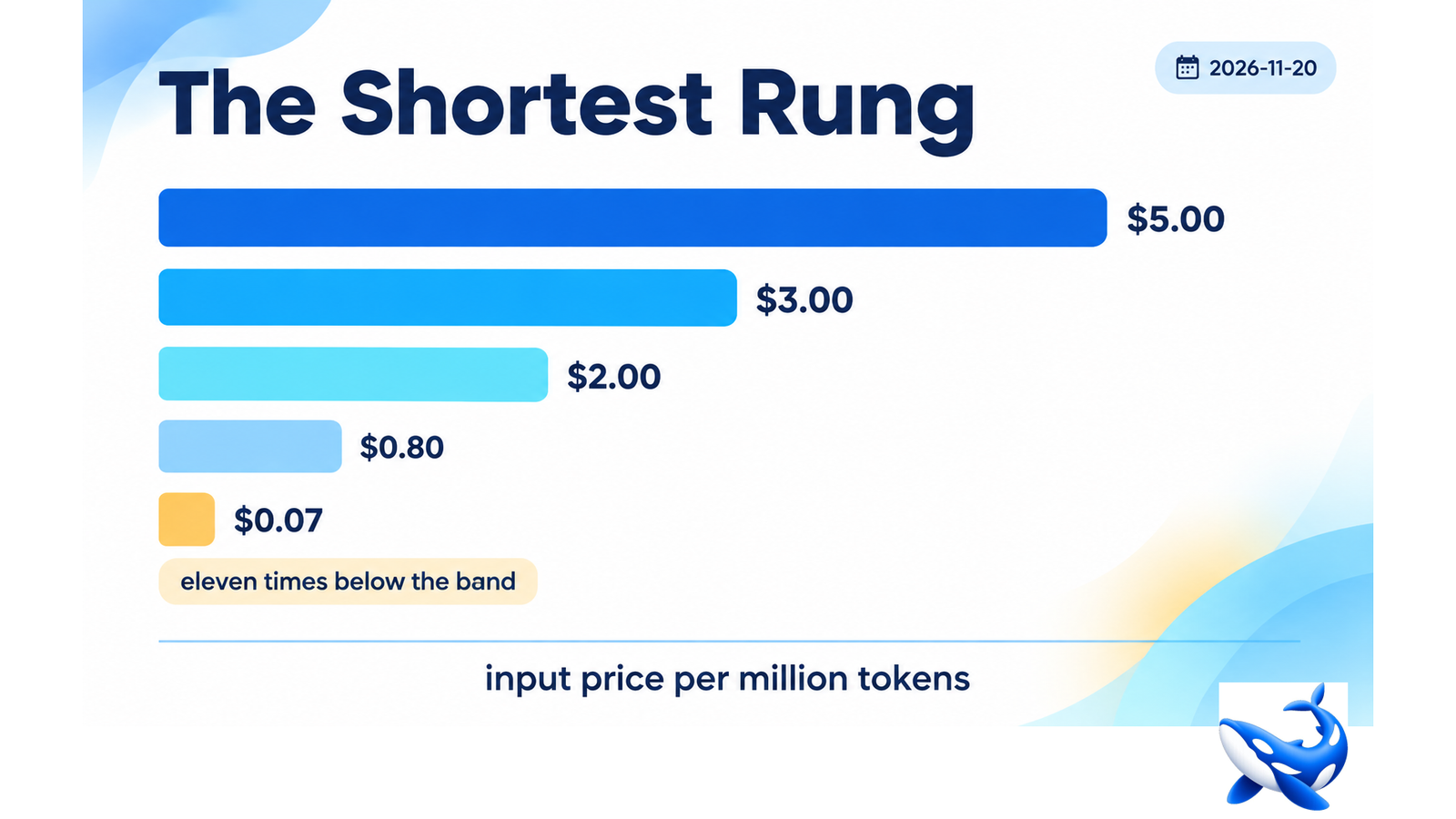
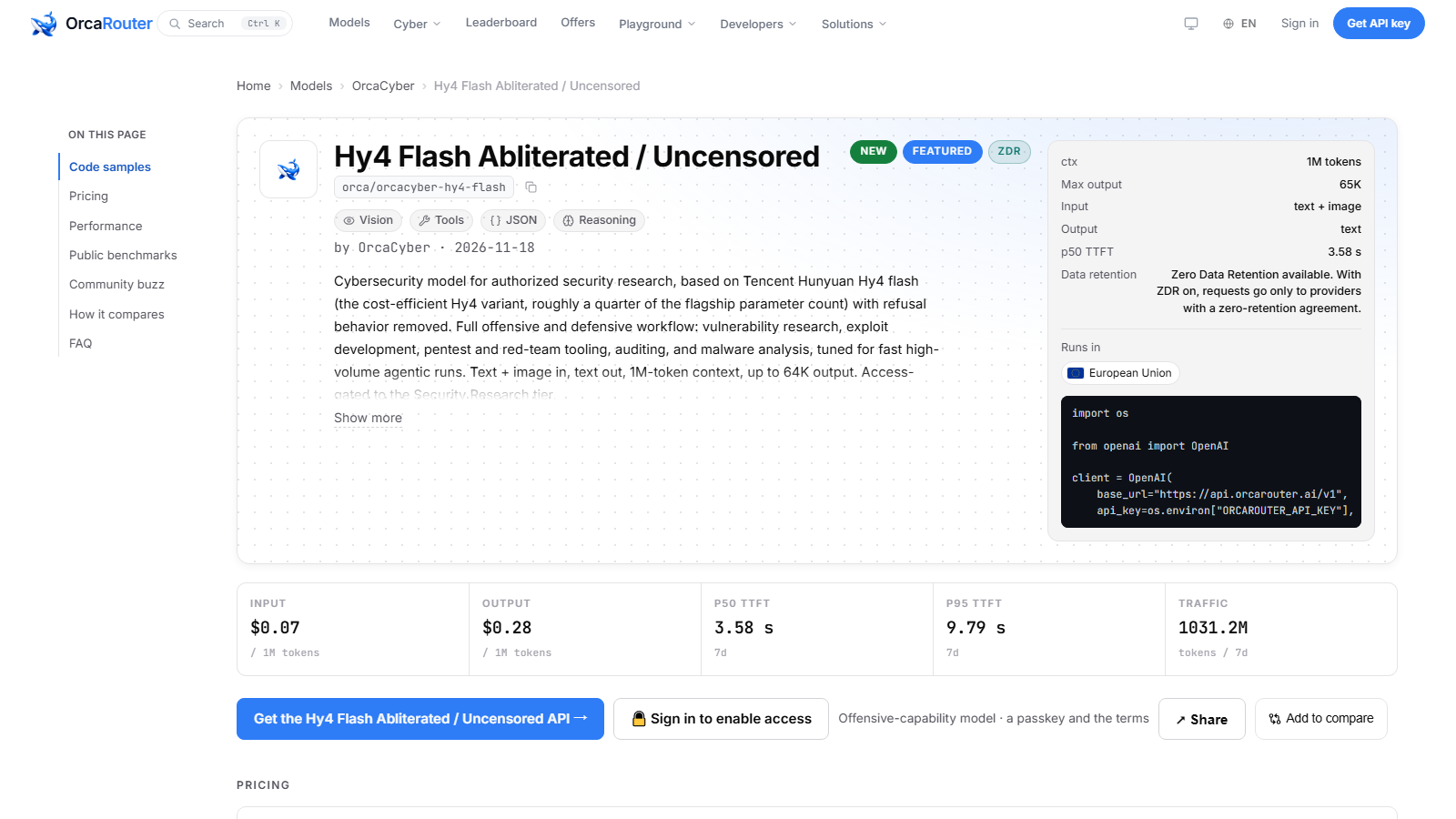
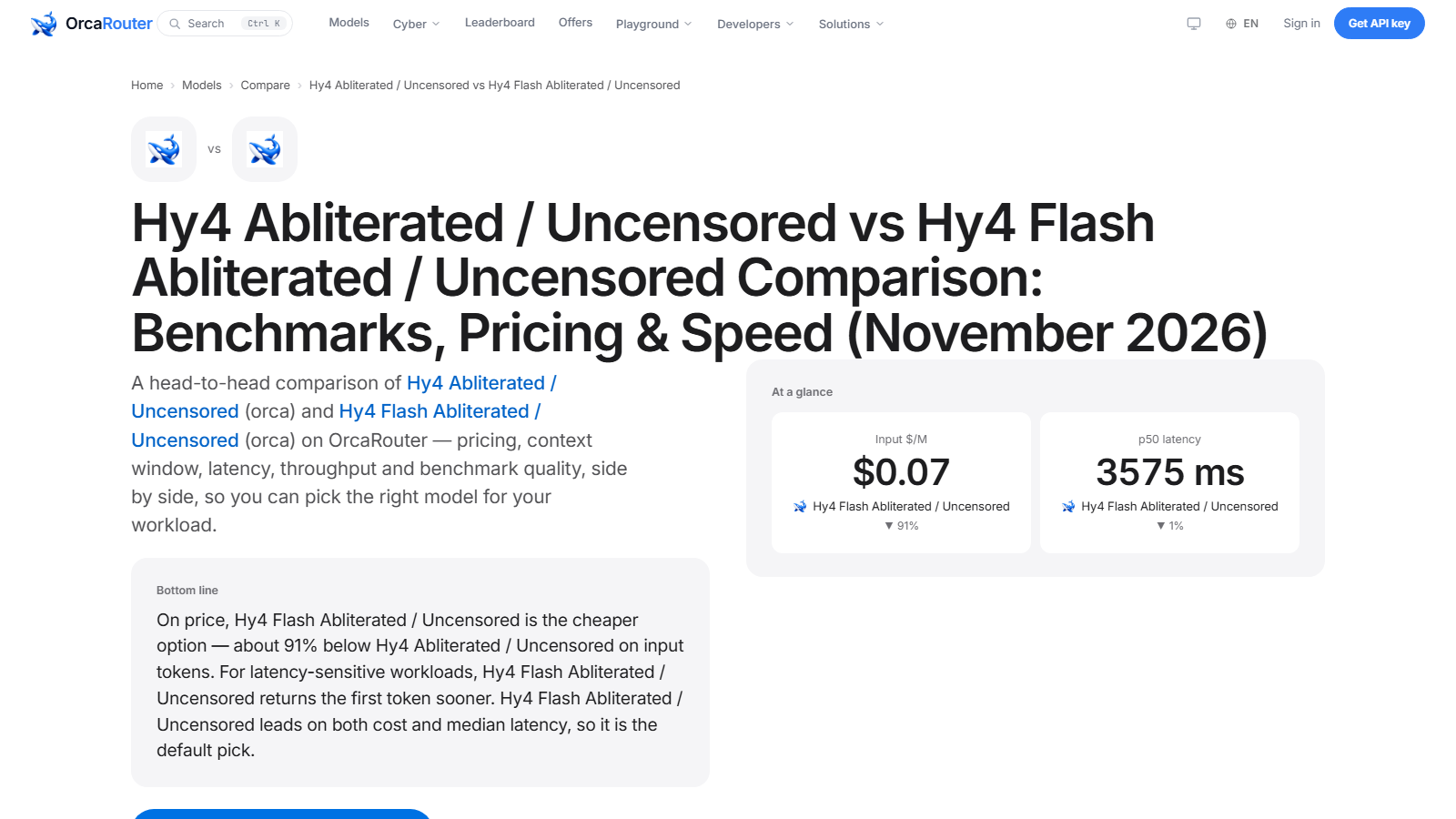
Seven cents per million input tokens is eleven point four times below the row that six cards in this tier share, and it is the lowest input price on any cyber card. OrcaRouter publishes the row alongside the model's own throughput. Both are on OrcaCyber Hy4 Flash: $0.07 in, $0.28 out, $0.003 cached.
The row, against every other row
| card | in $/M | out $/M | cache $/M | blend |
|---|---|---|---|---|
| Hy4 Flash | 0.07 | 0.28 | 0.003 | 0.1228 |
| Flash 1.0 | 0.80 | 1.60 | 0.15 | 1.0000 |
| GLM 5.3 Flash | 0.80 | 1.60 | 0.15 | 1.0000 |
| Hy4 | 0.80 | 1.60 | 0.15 | 1.0000 |
| MiMo V2.6 Flash | 0.80 | 1.60 | 0.15 | 1.0000 |
| MiniMax M3.1 Flash | 0.80 | 1.60 | 0.15 | 1.0000 |
| Qwen3.8 Flash Next | 0.80 | 1.60 | 0.15 | 1.0000 |
| K3.1 Pro | 2.00 | 5.00 | 0.35 | 2.7500 |
| GLM 5.3 | 3.00 | 5.00 | 0.30 | 3.5000 |
| Zero 1.0 | 3.00 | 7.50 | 0.75 | 4.1250 |
| Zero 1.5 | 3.00 | 7.50 | 0.75 | 4.1250 |
| Ultra 1.0 | 5.00 | 10.00 | 0.75 | 6.2500 |
The blended column is a 3:1 input-to-output mix. At 0.1228 this card is 8.1× below the band and 50.9× below Ultra 1.0.
Its output-to-input ratio is 4.01 — the widest in the tier. Every other card sits between 1.67 and 2.50. That means an output-heavy workload stays unusually close to the input price, which is the opposite of the usual pattern where a cheap input row hides an expensive output row.
What a blended tenth of a dollar buys in output
At $0.28 per million output tokens, a million tokens of generated text costs 28 cents. The same million costs $1.60 on six cards, $5.00 on two, $7.50 on two and $10.00 on one.
That is the whole of the price argument and it is genuinely unusual. But the card's published telemetry puts a different weight on it: 1.01 billion tokens in seven days, which is 0.9% of the tier's volume, producing $124 of bill — 0.05% of the tier's spend.
So the card is cheap and barely used. Both facts are published and neither explains the other. The candidate explanations are age and ceiling. It shipped 2026-11-18, two days before this measurement, so 1.01 billion tokens is a two-day figure being compared against seven-day figures for every sibling — and that alone accounts for most of the gap.
Normalising to a daily rate: 504 million tokens a day, against Flash 1.0's 5.2 billion a day. Even at the same age the card would sit at roughly a tenth of Flash 1.0's volume.
The ceiling is the constraint that does not move
The card's maximum output is 65,536 tokens and its window is 1,048,576. Both figures are shared with Hy4, its own non-flash sibling, and both are the smallest in the tier.
That matters more than the price for a specific class of job. An audit that produces a 100,000-token report cannot run on this card in one call, whatever it costs per token, because the ceiling stops at 65,536. The same job on Flash 1.0 has 393,216 tokens of room.
The ratio puts it plainly: 6.25% of the window, joint-lowest in the tier. A card that reads a million tokens and can only answer with 65,536 is built for short answers over long inputs — triage, classification, a verdict with a justification, not a full report.
That is a coherent design. It is also a hard limit, and the price does not change it.
The retry arithmetic on a cheap row
An error rate of 0.17% is the joint-second-lowest in the tier. At a $0.1228 blend, a billion tokens of traffic carries $215 of failure — against $1,684 on Flash 1.0 and $45,288 on Ultra 1.0.
| card | blend | fail $/billion |
|---|---|---|
| Hy4 Flash | 0.1228 | $215 |
| Hy4 | 1.0000 | $1,031 |
| Flash 1.0 | 1.0000 | $1,684 |
| MiniMax M3.1 Flash | 1.0000 | $1,794 |
| Zero 1.5 | 4.1250 | $3,517 |
| Zero 1.0 | 4.1250 | $3,790 |
| MiMo V2.6 Flash | 1.0000 | $4,209 |
| GLM 5.3 Flash | 1.0000 | $4,425 |
| K3.1 Pro | 2.7500 | $5,180 |
| GLM 5.3 | 3.5000 | $15,428 |
| Qwen3.8 Flash Next | 1.0000 | $15,972 |
| Ultra 1.0 | 6.2500 | $45,288 |
Retrying is therefore close to free on this card in a way it is not on any sibling. A pipeline that retries every failure three times adds roughly $645 per billion tokens of traffic — less than the cost of the original pass on most of the tier.
The cache row compounds it. At $0.003 per million, a cached prefix costs 4.3% of the input price, so a retry against a warm prefix is cheaper than a cold first attempt by a factor of 23.
The cache row, read as a fraction rather than a price
Three tenths of a cent per million is the smallest number on the tier's price table, and the ratio it implies is more interesting than the figure.
| card | input $/M | cached $/M | cache as share of input |
|---|---|---|---|
| Hy4 Flash | 0.07 | 0.003 | 4.3 % |
| Flash 1.0 | 0.80 | 0.15 | 18.8 % |
| Hy4 | 0.80 | 0.15 | 18.8 % |
| GLM 5.3 Flash | 0.80 | 0.15 | 18.8 % |
| K3.1 Pro | 2.00 | 0.35 | 17.5 % |
| GLM 5.3 | 3.00 | 0.30 | 10.0 % |
| Zero 1.0 | 3.00 | 0.75 | 25.0 % |
| Ultra 1.0 | 5.00 | 0.75 | 15.0 % |
At 4.3%, this card gives the smallest proportional discount on a cached read. A caller re-reading a million-token prefix saves $0.067 here and $0.65 on Flash 1.0.
That looks like a weakness and it is not. The absolute price of a warm million is $0.003, which is cheaper than any other card charges for a cold one by a factor of 23. A card does not need a large discount when its full price is already the floor.
The design reads as a deliberate one: price the input so low that caching is a rounding detail rather than a lever. On every other card in the tier, cache policy is a real decision with a real budget attached. Here it saves pennies.
The floor also changes what a failed request costs to repeat, which is the one place where a tiny price compounds. A cold retry of a full 1,048,576-token window is $0.0734 here and $5.24 on Ultra 1.0, a factor of 71. Applied to the seventeen failures a 0.17% rate produces in ten thousand calls, that is $1.25 against $89.13. A cheap card makes retry logic nearly free to run and therefore easy to justify implementing once.
That is the shape of a card priced to make a decision disappear rather than to win a comparison. There is nothing to optimise on this row, which is a different product from one that is merely cheap. The row also makes the card the natural default for a first experiment: when the cost of an unsuccessful bet is three tenths of a cent per million tokens, a team can measure the card on its own traffic before committing to a design around it.
OrcaCyber Hy4 Flash prices input at $0.07 and output at $0.28 — 11.4× below the $0.80/$1.60 row six cards share, and a 0.1228 blend that is 8.1× under the band. Its 4.01 output-to-input ratio is the widest in the tier, so an output-heavy job stays close to the input price instead of being taxed on the way out.
What the price does not buy is ceiling: 65,536 tokens of output against a 1,048,576-token window, 6.25% of what it reads. The card shipped 2026-11-18, so its 1.01 billion tokens is a two-day figure and the 0.05% bill share reflects age as much as adoption.
Sourcing note: the price rows, cache rate, throughput, error rate, context window, maximum output and the six benchmark scores are read from the OrcaCyber Hy4 Flash model API and card page on orcarouter.ai on 2026-11-20, with traffic, latency and error rates being OrcaRouter production telemetry for the days since release. The blends, multipliers, retry costs and bill estimates are our own arithmetic at a 3:1 input-to-output mix. The benchmark rows are vendor-reported and have not been independently reproduced. No competitor product is named or compared. Checked 2026-11-20.